Our online printing store allows you to select options for having the pages of a finished document collated. In some cases, however, the pages may need to be arranged in a specific order or layout to facilitate collating during the production process.
What is collating?
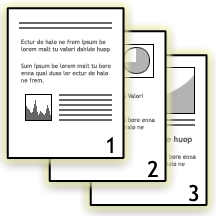
In printing, collating is the process of arranging the pages of a multi-page document in the correct, sequential order to create a complete finished set. Collation is performed during the finishing process and may be followed by binding the pages together. For example, the image shows a three page document, page 1, followed by page 2, followed by page 3 - the same sequence the pages are read.
What is reverse collating?
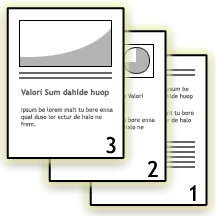
Reverse collating is the process of arranging the pages of a multi-page document in reverse sequential order. Instead of placing the pages in the usual order - page 1, followed by page 2, then page 3 - the pages are arranged in reverse: page 3, followed by page 2, then page 1.
What does uncollated mean?
An option to order a multiple page document without collating, means that each page will be delivered in separate stack or bundle. For example, all copies of page one will be in one stack, all copies of page two in another stack, and so on. The pages are not arranged into complete sets.
What is slip sheeting?
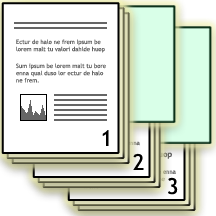
In printing, slip sheeting is the process of placing a blank piece of paper between groups of printed pages. It can be used with collated or uncollated pages. Slip sheets make it easy to see where one set stops and another begins, particularly when printed materials are stacked loosely or packed in cartons.